Sunday, December 23, 2012

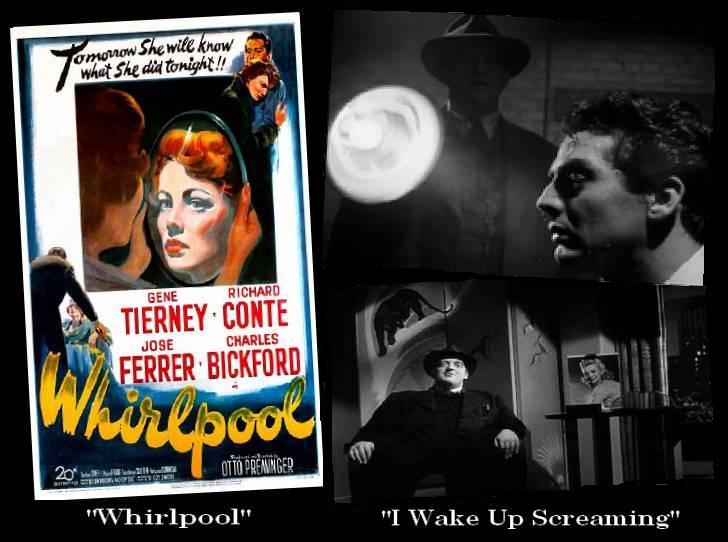
Whirlpool and I Wake Up Screaming

Christmas. Bah. Humbug. These are dark days. With good cheer in short supply, I’ve been watching movies from the Fox Film Noir collection.
Whirlpool stars Gene Tierney, Jose Ferrer, and noir icon Richard Conte. It’s a movie that I recall sort of half watching one summer evening in 1971 when it aired, as so many Fox titles did at the time, on a local television station’s late night movie. It’s an oddball little mystery from 1949 written by Ben Hecht and Andrew Solt (from a novel by Guy Endore) and directed by Otto Preminger who made quite a few contributions to this subgenre (including Laura) before directing a bunch of less interesting “prestige” items like Exodus and The Cardinal in the 1960s. Tierney is the wife of a psychiatrist who is taken under the wing of Ferrer’s hypnotist after she’s caught shoplifting. He then hypnotizes her to take the fall for a murder he commits himself. He has the motive, but he also has an alibi. While the victim was meeting her end, he was confined to a hospital bed, on the mend from a gallbladder operation. The nasty hypnotist (David Karvo is the character’s name) had hypnotized himself to block out the excruciating pain, snuck out of bed, and committed the crime. A little preposterous, perhaps, but fascinating stuff. Film noir is notable for many things, not the least of which is its perversity. Only the horror movies had more bizarre plots. Whirlpool is as weird as it gets, but it could have used a better title, something like . . .

I Wake Up Screaming.

Now, that’s a great title. All it needs is a movie as good, but the 1941 production directed by H. Bruce Humberstone, isn’t really it. It’s not surprising that Twentieth Century Fox considered renaming it Hot Spot and even had ads printed with that title before the movie went into release. If the movie isn’t quite worthy of its title, it does have an effective villain in Laird Cregar. The hulking, soft-voiced actor, a memorable menace in such films as Hangover Square and The Lodger, is first seen in shadow as he turns the hot lights on Victor Mature, a sports promoter being interrogated as a suspect in the murder of an actress. As the captain in charge of the case, Cregar ignores evidence of Mature’s innocence and even admits to investing his own time and money into finding a way to pin the rap on him. Cregar, of course, is the true culprit who we learn at the climax has a shrine to the murdered girl in his apartment. Betty Grable and Carole Landis round out the cast though I’d be hard-pressed to tell them apart, and Elisha Cook, Jr, who appeared as Wilmer the gunsel in The Maltese Falcon the same year, turns up briefly as a hotel desk clerk who is also a suspect. The best moment, and the only one that ties in with the title, is when Mature wakes up in his bed to find Cregar sitting in a nearby chair, rather nonchalantly keeping watch over him even as he sleeps. The movie, a fairly solid thriller, would be much improved without its musical score. Except for the snatches of “Over the Rainbow” (yes, that “Over the Rainbow” from The Wizard of Oz), I could swear the musical score is identical to the one in Whirlpool.

Merry Christmas.

© 2012 Brian W. Fairbanks

VISIT MY KINDLE STORE AT AMAZON

Tuesday, November 20, 2012

Marilyn C. Szalay (1950-2012)


“Life Drawing went exceptionally well today. Not once did the teacher berate or mock my drawings, as she is often inclined to do.” – Journal entry, Tuesday February 2, 1990

Marilyn Szalay could mock and berate, and frequently did, but she was also quick to offer praise when it was due. As one of her Life Drawing students at Cuyahoga Community College throughout 1990, my work was mocked and praised in equal measure.

The mockery was deserved. Even though I had been drawing since I was old enough to be trusted with a pencil, I had, even at age 32, a habit shared by most of my classmates. After completing a drawing, I would take my pencil and add a bold outline to every object in my composition. Szalay was not a fan of lines (“There are no straight lines on the human figure”) or line drawings ("Lines are for coloring books," she cracked), and her criticisms were rarely stated gently. Her comments broke my bad habit immediately and I never again added a silly, and unnecessary, outline to one of my drawings. “Stick with me, Brian,” she once told me, “you’ll learn a lot.” Indeed, I learned everything I know about drawing from her, and much of what I learned went beyond drawing and served me well in other areas. She taught me how to draw. More importantly, she taught me how to SEE – shapes, variations in light and dark, and to regard the human figure as something other than a series of isolated parts.

Szalay could be abrasive and rubbed some students the wrong way. I was one of them at first. “This is beautiful,” she said of a drawing I did of a female model. Then, pointing to the stool on which the model sat, “but this is awful. It’s like two different people worked on this drawing, one sensitive and the other a klutz.” As she pointed out the shortcomings in my work during the weekly homework critique, I would stand there, speechless and embarrassed. She was right, of course. She was always right, and my work improved after every such thrashing. I quickly grew to love her as much as I respected her talent. As I noted in another journal entry, this one dated April 14, 1990:

“She had things to say, good and bad, about everybody’s drawings but she said nothing to me. That may mean she thought I was doing well – I don’t know – but I do know I felt kind of hurt by the lack of attention. Earlier in the day, she said, ‘Oh yeah, Brian is getting good’ in response to another student’s remark about one of my drawings . . . Later, while I drew a second portrait, she did have a few words, most of them good. Maybe I’m too sensitive. As I made my way out of the class and passed her in the hall, she said, ‘Good going, Brian.’ That was nice. I guess I’m becoming rather fond of this woman and want her attention.”

When the attention was positive, I was euphoric. “Look at this hand!” she exclaimed to the class when holding up an ink drawing I had done as a homework assignment. “Now this has drama!”

Except for the F's I routinely received in Algebra, I was a straight A student until Szalay gave me a B in that first Life Drawing class. However, when she gave me an A the next quarter, and the quarter after that, they were the most gratifying A’s I would ever receive. She was strict about grades, and warned her students that they had to earn them. Simply showing up for class and completing assignments might guarantee a C at best, but not the A or B that more lenient Art teachers were known to give. This came as bad news to the EMS student who took Drawing in fall 1990 only to meet a college requirement in Humanities. As for my A, I earned it because I learned it – from her.

She often teased me about my quiet manner even as she enforced a rule against talking while drawing. One talks with the left side of the brain and draws with the right, she told us. To engage in left brain activity while drawing might interfere with the right brain’s ability to think creatively. It was one lesson that she never had to teach me. I recall the time that she sent the class into the hallway for a perspective assignment. She was annoyed at all the chatter she heard. After making her displeasure known, she threw a sort of compliment my way:

"I don't have to worry about Brian," she said. "He never talks. He just grunts."

Marilyn Szalay passed away on November 3, 2012. She was only 62 and spent her last decade battling scleroderma. The news makes this season of Thanksgiving a downer. However, it also reminds me to be thankful that my life was touched by her intelligence and talent.

Another journal entry, this one from Tuesday October 23, 1990:

“In Drawing III, we resumed work on the still life that we started last Tuesday. Things went much better today than they did then, although Szalay complained about a lack of drama in my drawing. ‘You could have the world if you just pushed a little harder,’ she said. ‘Do you want it?’”

The world was certainly worth having when she was in it. Its value is diminished now that she's gone.

Goodbye, Teacher, and thank you.

© 2012 Brian W. Fairbanks

VISIT MY KINDLE STORE AT AMAZON

Thursday, November 15, 2012

"A cinch . . . the Perfect score"

Fifty-three years ago on this date, a Kansas farmer named Herbert Clutter was awakened sometime after midnight by two intruders who let themselves in through an unlocked door. In 1959, especially in the tiny town of Holcomb, population 270, any threat to one’s safety came from outside the community, from the Communists maybe, but not from the neighbors. The young men who came to the Clutter farm armed with shotguns and a flashlight had recently been paroled from the Kansas State Penitentiary. It was there, while sharing a cell with a petty thief named Floyd Wells, whom Herbert Clutter once employed as a farmhand, that Dick Hickok concluded that the Clutter home held a safe stacked with cash. It was, as Hickok said in a note to accomplice Perry Smith, a “cinch, the Perfect score . . .”

But there was no safe. Instead of the fortune they had anticipated, Hickok and Perry left the Clutter home with a small amount of cash and a radio taken from Clutter’s office. It may have been a “cinch,” but it was not the “Perfect score.” If he exaggerated the financial rewards of their criminal undertaking, Hickok was accurate in his promise to leave no witnesses. “I promise you, honey,” he told Smith, “we’ll blast hair all over them walls.”

Horrific as the murders were (Herb Clutter, his wife Bonnie, son Kenyon, and daughter Nancy, were bound, gagged, and killed at close range by blasts from the shotgun), they would almost certainly not be remembered outside of Kansas itself more than a half century later if not for Truman Capote who, reading a brief account of the murders in The New York Times, departed for Kansas with his childhood friend, Nelle Harper Lee, whose Pulitzer Prize winning novel, To Kill a Mockingbird, had yet to be published. Capote was to write an article for The New Yorker, described by Brendan Gill, a fellow scribe for the periodical, as “the effect of a murder – a story of a small Midwestern town responding to an unprecedented catastrophe in their midst.” Lee was present not to write but because she was, in John Barry Ryan’s words, “a fairly tough lady, and Truman was afraid of going down there alone.”

According to Charles J. Shields’ Lee biography, I Am Scout, Lee was put on salary as Capote’s “assistant researchist,” and wrote copious notes, enough of which would end up in what became the novel, In Cold Blood, to justify her receiving more than the dedication in the opening pages.

“Nelle was very hurt that she didn’t get more credit because she wrote half that book,” a friend, R. Philip Hanes, recalled. What originally began as an article for The New Yorker evolved into the enormously successful In Cold Blood which started a wave of “true crime” books that has not abated since Capote’s book reached stores in early 1966. Although Capote’s technique, using the tools of the fiction writer to tell a true story, make it controversial, and the debate concerning whether it was fact or fiction which continues to this day, may have cost him the Pulitzer and the National Book Award, the book was a phenomenal success on every level, guaranteeing that the Clutters would be killed again and again when the book became a much praised 1967 film, and a rather obscure 1997 TV mini-series. In 2005, Capote’s experience researching the book became the basis for two films, Capote and Infamous, both of which recreated the brutal slayings. When the Clutters went to bed on Saturday November 14, 1959, they had no idea that they wouldn’t live to see another morning, and their killers certainly did not realize that someone other than themselves would walk away from the scene with the fortune that was denied them. In Cold Blood became Capote’s masterpiece and the royalties kept him rich even as his pen went dry.

If the films are accurate, the book ultimately destroyed him. In Infamous, Capote is portrayed as being in love with one of the killers, Perry Smith, who had artistic ambitions of his own. Watching Smith die by hanging, and secretly wishing for his demise so as to conclude his book with a dramatic execution, traumatized the author. That’s one theory. The same film suggested that his excursion to Kansas and exposure to the hard realities of life that he was protected from when hobnobbing with New York society and Park Avenue life, changed him and made him more fearful, paranoid, and hopeless. Piedy Lumet, wife of the director Sidney Lumet, told George Plimpton of a trip she took to Oregon with the elfin author. She stopped the car to take a walk through a path of redwood trees leading to a state park while Capote waited behind in the car. “This was a year after Perry and Dick had been executed. I heard this piercing call of alarm from Truman: ‘Come back! Come back! Perry and Dick are down there!’ It wasn’t a joke. A terribly, poignant intensity. He just got frightened. It didn’t make any sense and I never made any reference to it.”

Author John Knowles thinks it was simple a case of too much success. “I think he lost a grip on himself after that. He had been tremendously disciplined up to that time. . . A lot of his motivation was lost. That’s when he began to unravel.” Capote died August 25, 1984 at age 59 in the Los Angeles home of Joanne Carson, former wife of Tonight Show host Johnny Carson whom Capote met when the couple lived in the United Nations Plaza where the author moved following the windfall of In Cold Blood. He had published the short novella, The Thanksgiving Visitor in 1968 and a collection of stories and essays, Music for Chameleons, in 1980, but had not written another major work. His long promised epic, a roman a clef called Answered Prayers, materialized after his passing, but it was hardly an epic. A short book with four chapters, two of which had been published in the pages of Esquire in 1975, alienating the New York society crowd, it was either never as close to completion as Capote claimed or pages were stolen after his death. Carson was worried about his health during his stay. His pulse was weak and his complexion pale. “I’m tired,” he told her. “I don’t want any more hospitals, any more doctors, any more IVs . . . I’m very, very tired. I just want to go in peace.”


© 2012 Brian W. Fairbanks

VISIT MY KINDLE STORE AT AMAZON

Wednesday, November 14, 2012

The new Bond movie


Skyfall, the latest 007 opus, is getting raves. “It’s the greatest Bond movie ever!” I heard someone exclaim. After catching it the other night, I beg to differ. I’d rank it somewhere in the middle, not in the same league as Thunderball (still the biggest grossing Bond film when inflation is taken into account, as it rarely is) or On Her Majesty’s Secret Service, but several flights of stairs above The Man With the Golden Gun. Nonetheless, it is a terrific entry in the now 50-year-old film series (you won’t hear the word “franchise” from me). I can’t claim to be objective though. No matter how good, or how technologically advanced, no Bond film after 1971 is going to compare in my mind with those first seven films, six starring Sean Connery and one with George Lazenby. That was Bond’s cinematic heyday.

Skyfall is Daniel Craig’s third go-round as Ian Fleming’s secret agent, and it sure has it over the disappointing Quantum of Solace. The story has the identifies of MI6 agents being revealed when a computer file goes missing, but what does it matter? There are several spectacular action scenes, and a nail-biting moment when Bond, on the trail of an enemy, clings to the bottom of an elevator that rises high above Shanghai. The film’s climax takes place in Bond’s rustic childhood home (the “Skyfall” of the title) where he and M have an almost Western-style showdown with the bad guys led by chief villain Javier Bardem. The Spanish actor goes blonde for his Bond baddie (as Robert Shaw did in From Russia With Love and Christopher Walken did in A View to a Kill), and plays it kind of fey. He makes for a very formidable foe.

Skyfall has one of the most high profile casts to ever appear in a Bond film. In addition to Judi Dench returning as M, and Oscar winner Bardem, there’s Ralph Fiennes who we’ll obviously be seeing again, and Albert Finney, burly and bearded, as the man who raised Bond as a child. The music score by Thomas Newman includes occasional snatches of “The James Bond Theme,” and the legendary gun-barrel opening, missing from recent films, is tacked on at the end. A good show all around.

© 2012 Brian W. Fairbanks

VISIT MY KINDLE STORE AT AMAZON

Sunday, October 21, 2012

Haunting Memories

“Scream . . . no one will hear you! Run . . . and the silent footsteps will follow! . . . for at Hill House the dead are restless!”
Poster copy for The Haunting (1963)

Halloween is right around the corner, and we’re sure to see the predictable lists containing the most frightening movies of all time. In most cases, the titles will also be predictable – The Shining, The Exorcist, Jaws. Less likely to be included, though probably as predictable as the others, is my own choice for the scariest movie: The Haunting, the 1963 original (a more gruesome and less imaginative remake appeared in 1999) based on Shirley Jackson’s novel. Movies about things that go bump in the night rarely remain scary on repeat viewings since you can anticipate where those bumps will be, but though The Haunting holds few surprises for me now, it remains the best ghost story ever put on film. From a journal entry dated July 17, 1990, here are some rather persoanl memories of that film:

When paging through Stephen King’s Dance Macabre, I was pleased to find so much space devoted to Shirley Jackson’s novel, The Haunting of Hill House. Jackson also wrote “The Lottery,” the classic short story that has probably been anthologized more than any other horror tale. The Haunting of Hill House is a great book, and few films are as frightening as the 1963 black-and-white classic released under the abbreviated title, The Haunting.

Directed by Robert Wise following his Oscar win for 1961's West Side Story, this adaptation of Jackson’s story puts most subsequent ghost stories to shame. There are no white sheets floating through the hallways, no monsters, and no rotting corpses rising from the floorboards as there were in 1982's Poltergeist, but that later film can’t hold a candle to The Haunting which relies on subtlety and suggestion for its horror and does so more effectively than any other film I’ve seen.


Director Wise, best known for putting the Jets and Sharks through their paces and for bringing the hills alive to The Sound of Music, was no newcomer to the horror genre. His debut as a director came with Val Lewton’s 1944 production, The Curse of the Cat People. A year later, he led Boris Karloff and Bela Lugosi through the mayhem of The Body Snatcher. In 1951, he directed the science-fiction classic, The Day the Earth Stood Still.

The Haunting concerns a group of people, all of whom have had a brush with the supernatural, meeting in a brooding century’s old house that is said to be haunted. At least one of the guests, Eleanor, played by Julie Harris, may be haunted herself. There are strange occurrences, including loud noises in the night and a crashing chandelier, and no one is sure whether these events have to do with the house or the sensitive, neurotic Eleanor. After all, both are a little strange. Still, the mansion in which the story unfolds is a frightening, unusual place where “whatever walked there, walked alone.”

I first saw The Haunting in its entirety in the mid-‘60s when it aired on ABC-TV, but I saw the first ten minutes on Sunday November 24, 1963 at the now demolished Garden Theater, a second run movie house on West 25th Street in Cleveland, Ohio where it played on a double bill with Hammer’s Kiss of the Vampire. My mother had promised to take me on Friday night (the Garden was only open on weekends), but President John F. Kennedy had been assassinated earlier in the day, and the theater, like the whole country, was closed for business. I was disappointed that our Commander-In-Chief’s death interfered with my movie going plans (I was only six years old, and the death of a president was beyond my intellectual grasp at the time), but my cousin agreed to be my escort the following Sunday afternoon. Since I was mainly interested in seeing the full color vampire film, we didn’t stay to see all of The Haunting. That was fine with me. Based on those first ten minutes, The Haunting looked a bit too scary, even a little depressing. At the time, I preferred decidedly more ghoulish thrills, the kind that a colorful Hammer horror could provide.

When I finally caught up with The Haunting on television, I realized my original hunch was correct. This movie was too scary. It remains scary now. It’s the rare film that can truly give me goose bumps and make me turn around to see if a ghost is lurking over my shoulder when I watch it.

All these years later, The Haunting haunts me still. Whereas Poltergeist leaves me repulsed, The Haunting continues to work on my imagination. It is, after all, a film that one experiences in one’s own mind. Director Wise doesn’t show us the horrors. Instead, he does something much more frightening: he lets you imagine them yourself.

July 17, 1990

© 2012 Brian W. Fairbanks

VISIT MY KINDLE STORE AT AMAZON

Tuesday, October 9, 2012

John Lennon: Happy Birthday to You!

John Lennon would have been 72-years-old today. Had an assassin not emerged from the shadows of New York’s Dakota apartment building on the evening of December 8, 1980 and ended Lennon’s life only two months after his 40th birthday, where would the man who founded the Beatles and provided the British quartet with its most distinctive voice be today?

Of course, it’s possible that the assassin, having missed his chance on December 8, may have returned and tried again on December 9 or 10, or some later date, and Lennon would still have fallen victim to those bullets. If an assassin hadn’t succeeded in killing him, maybe cancer, heart disease or another “natural cause” would have claimed him by now.

Let’s assume, however, that Lennon had successfully dodged the bullets, both real and metaphorical. What would he be doing now?

Shortly before his death, he joined wife Yoko Ono and recorded his first album of new original material in six years. It had been five years since Shaved Fish, his first greatest hits collection, had been released, and Lennon all but disappeared from public view after 1975. Having been one of the most public of public figures during the early ‘70s, appearing frequently in the press and on television talk shows as he battled the government’s efforts to deport him, he was conspicuous by his absence. His sudden reemergence in 1980 all but guaranteed the success of Double Fantasy. After his death, it became his third post-Beatles album to reach number one on the Billboard chart (1971's Imagine and 1974’s Walls and Bridges were the others).

It would be nice to think that he would have gone on to greater success in the years to come, but a look at the track records of his fellow superstars from the 1960s and 1970s suggests he would not. Following 1983, his more commercially-minded former partner, Paul McCartney, struggled to have hits, and wouldn’t see one of his albums reach the top 10 again until 1997; the same year Bob Dylan also made a comeback with the Grammy winning Time Out of Mind. Dylan had also hit the skids in the dreary ‘80s, and, unlike McCartney, even struggled to sell tickets to his concert appearances. Even Neal Diamond, who, by then, had defined “middle of the road,” found his albums floundering near the bottom of the top 40.

Would Lennon have fared any better?

I doubt it. This might have been good news for those Beatle fans clamoring for a reunion. The three surviving band-mates reconvened in 1995 for the only reunion possible by then, adding their voices and instruments to several Lennon demos. Had Lennon lived, I think he would have joined them. The Beatles might then have reunited more or less permanently, issuing new songs every few years (none of them likely equal to “Strawberry Fields Forever” or even “Your Mother Should Know”), and embarking on mega-tours like the ones that the Rolling Stones use to rake in the dough several times a decade.

Another possibility, one that Lennon even acknowledged as an option when interviewed by Rolling Stone in 1980, was television. Yes, John and Yoko who spent a week co-hosting The Mike Douglas Show in 1972, and also chatted freely with Dick Cavett and David Frost during the same era, might have their own talk show now, or, God forbid, a reality show, probably titled The Ballad of John and Yoko.

I’d rather not think about that, even though it’s obvious that I already have. It’s best to remember him the way he was, as Bob Dylan has done in “Roll On, John,” the closing track on his latest album, Tempest:

“Shine your light, move it on, you burn so bright, roll on, John.”


© 2012 Brian W. Fairbanks

VISIT MY KINDLE STORE AT AMAZON
Monday, October 1, 2012

X - The Chemtrail Question


When I stepped outside one recent morning, I was confronted with a large X. It hovered in the sky above me, and the effect of the sunrise gave it a red, and, therefore, more ominous appearance. The X was the product of chemtrails, and the sky was positively wild with these mysterious apparitions on this particular morning. In addition to that X, two barely visible planes were in flight spraying what the “conspiracy theorists” insist is poison, a combination of aluminum and other substances unfit to be inhaled by humans.

A search on the internet for information about chemtrails that is not conspiratorial is pretty futile. I would like answers to the following questions:

What are they spraying?

Why are they spraying?

Who is spraying?

Who is paying for the spraying?

Who is paying for the fuel to power the airplanes?

Who is paying the pilots who fly the planes?

Who is paying for the planes?

When the planes are not in flight, they need to be warehoused somewhere. Where are they warehoused and who is paying for that? The planes are also in need of repair from time to time. Who repairs them? Who pays the repairmen and who covers the cost of those repairs? Who hoses them down and scrubs them clean?

I’m pretty sure that I know the answer to my questions concerning the cost of all this mysterious spraying. I pay for it with my tax dollars, as does everyone who heeds the call of the IRS every spring. The other questions have not been answered to my satisfaction.

It’s a rare day, indeed, when I don’t see chemtrails. I often find myself wondering if there any genuine clouds in the sky or if all those white fluffy apparitions are chemicals. Whatever they’re spraying doesn’t remain airborne, but eventually falls to earth where it then makes it way through our nostrils to our lungs. And let’s not overlook its effect on plant life and our water.


The government usually reacts to questions regarding chemtrails with silence and maybe a chuckle. Those who worry about such things are “conspiracy theorists,” after all, and not worthy of serious attention except, perhaps, from the Department of Homeland Security who might perceive them as a threat to our crumbling democracy. Occasionally, however, they have made claims that the spraying is necessary for a variety of reasons. It blocks enemy radar. It protects us from Global Warming. It does this, it does that, but what is all that spraying doing to our health?

According to Dan Bidondi, a pilot writing at Infowars.com, “there is a huge difference between condensation (con-trail) and a chemical trail (chemtrail). A condensation trail dissipates as the jet moves along; a chemtrail will stay and expand into man-made clouds used for various weather experiments loaded with toxic chemicals that we breathe in on a daily basis.” The chemicals include arsenic, barium, depleted uranium, mercury, and aluminum.

For more information on chemtrails, from a conspiratorial point of view, watch What in the World Are They Spraying?

© 2012 Brian W. Fairbanks

VISIT MY KINDLE STORE AT AMAZON