Friday, January 11, 2013

Nature or Nurture?

On this, my 90th birthday (or so my aching bones suggest), I could think about the many things that went wrong in my life, but instead I'll be positive and think about what went wrong in the lives of others.

Nature or nurture?

Which defines a person's character?

Is it a little of both?

The question comes to mind after spending a couple of hours searching through the court docket at a county web site. Type in a name and you get the criminal history of county residents. So many of the people with whom I crossed paths in my youth, often as classmates in Catholic school, have criminal records, and a number of them have died of something other than natural causes.

Dennis D. (last name withheld to discourage lawsuits from survivors), the ferret-faced loser who tried to sell me some catnip for a dollar back in 1971 (claiming it was marijuana), spent several years in a "correctional facility" after two different drug busts. He was apparently selling drugs in the vicinity of a schoolyard when he was arrested in 1999. He was about to begin another period of incarceration when, on May 31, 2000, "the court being notified of the death of the defendant, and being satisfied of the truth thereof. . ."

Well, it's hard to prosecute a corpse, so Dennis, at age 43, left this earthly realm to face a more fearsome judge in the hereafter. The cause of death was not available but I assume drugs were involved there, too.

Mark M. was the younger brother of a kid who died in 1970 at age 16 after he caught fire while simultaneously smoking a cigarette and siphoning gas from a car. (Brains were not abundant in the “hood” of my youth.) On February 9, 1994, the kid brother, obviously having failed to learn from his older sibling’s mistakes, was facing charges of felonious assault. He, too, avoided time in a correctional facility when "the court being notified of the death of the defendant, and being satisfied of the truth thereof. . ."

Like Dennis D., Mark M. exited this world for one in which the judgment is truly final.

And there are others. . .

Billy H. went up in flames at age 27 in 1982, not long after he was released from a "correctional facility" where he had been sent after inserting a knife into someone’s gut. Upon his release, unemployed and without prospects, he moved into his parents’ garage. On a crisp October night, a fire broke out. The suspicion was that he was either asleep or simply too high to notice the fire, which probably resulted from the careless smoking of an illegal substance. There was a certain poetic justice in his fate. As a teenager, he was notorious for setting off fire alarms. Now, the fire department was notified too late to save him, and he died, of smoke inhalation, at a hospital less than a quarter of a mile from his home.

I became acquainted with Billy H. through John S. who acquired the nickname of Hardy due to his resemblance, in weight only, to Stan Laurel’s on-screen partner. I had known him since third grade when he followed me home from school and pestered me into a relationship that continued through high school. A classic “latch-key kid,” his mother worked and his father was a drunk. The father was also a bully, and John S. was a bully who later became a drunk. It’s as if he was handed a script at birth and followed it faithfully, having been too unimaginative to improvise.

“How come you're not a drunk like me?" he asked when I saw him for the last time two years before he reached his expiration date. "You lived the same way I did."

I never lived the way he did. My "best friend" never realized that when I reluctantly accompanied him in wandering the streets and, later, hung out at the playground where he had found a home and family with the thugs who loitered there, I was merely physically present, an observer in his life. A quiet, self-contained lad, I would have preferred to stay home and read, write, draw, watch movies, etc. I savored my solitude and needed no companion other than my imagination. True, I seemed to have lived the way he did. When in the company of the "friends" of my youth, I did as they did. I drank beer, I occasionally smoked dope, and listened to the music they favored (Black Sabbath, Aerosmith, Hawkwind). But I only drank ONE beer, two at most, while my companions downed one after another and encouraged me to do the same.

"He sips his beer," John S. would point out.

"Gulp it!" he'd say before gulping his Colt 45 to demonstrate the technique.

But I didn't "gulp." I defiantly "sipped." Once I got home, I returned to my life which I shared with no one.

John S.’s fate was sealed from the beginning. When I learned he had been found dead at age 35 in a room in the house of a friend (for which he could never pay rent), I was neither surprised nor saddened. I remembered how, following the death of a 12-year-old girl in seventh grade, he would chuckle as he lowered his head in mock solemnity when passing her house. When I once expressed the wish to be cremated when I died, he sneered and asked, “Who’d want your ashes?” Now he was cremated, his ashes dumped, per his request, on the playground that represented his only true home. His death also went unnoticed since no one bothered to pay the fee for a newspaper death notice. What a man sows, surely he shall reap. John S. sowed nothing but misery, and he met a miserable end.

I know little about the home lives of the others who met premature and unnatural ends, but, like me, they all came from working class families and were raised in the foreboding shadow of the Catholic Church. Lord knows I’m far from perfect, but I’ve never been arrested, I’m not a drunk, and I find nothing amusing about the death of a child. Oh, and I’m still alive, if not that lively.

Nature?

Nurture?

A little of both?

Are some people just born assholes?

© 2013 Brian W. Fairbanks

VISIT MY KINDLE STORE AT AMAZON

Sunday, January 6, 2013

Elvis Is Everywhere

Elvis Presley would have turned 78-years-old this Tuesday, January 8. I can’t forget the King on his birthday even if he isn’t around to celebrate. Here, from 2002, is my tribute to a man who truly changed the world:

“Before Elvis, there was nothing.”

John Lennon's frequently quoted tribute to the King of Rock and Roll is an exaggeration. Before Elvis, there was the girl, name unknown, who won first prize in the talent program at the Mississippi-Alabama Fair and Dairy Show on October 3, 1945. Ten-year-old Elvis Aaron Presley won second place singing 'Old Shep,' a heartbreaker about a boy's love for his doomed dog. Years later, with characteristic modesty, Elvis would remember finishing fifth or even seventh in the contest, but no matter. He won the competition that counts.

Today, you can visit any record store and search the bins in vain for even one recording by the first place winner. But, as a song by Mojo Nixon declares, Elvis is everywhere.

For his performance at the fair, Elvis won five dollars and a free ticket to all the rides. With stardom, the five dollars multiplied into millions, and Elvis still had a ticket to all the rides, including the chemical kind that most reports indicate were in his system on the afternoon of August 16, 1977 when his lifeless body was found at Graceland, his estate in Memphis, Tennessee.

There are those who maintain that drugs were not a factor in his death, that the original autopsy citing an irregular heartbeat was correct. But the conflicting reports about the cause of his death are just another part of the mystique of the man for whom even the word "superstar" always seemed inadequate.

This year marks the twenty-fifth anniversary of his death, and some fans remain convinced he did not die at all, but fabricated his demise to escape the burdens of fame. Silly as these true believers often seem, you can't blame them. In a sense, Elvis is more alive than ever.

Although none of his 33 movies earned Oscar nominations, three of 1994's Best Picture nominees (Forrest Gump, Pulp Fiction, and Quiz Show) refer to him, as have too many movies and TV shows to count. There are songs about him and enough books examining his legend to stock a special Elvis section in a large bookstore or library. Greeting cards bear his likeness, as do collector plates, and virtually any product that has room for his portrait.

He's been officially recognized by the United States Postal Service with a stamp in his honor, and his gaudy estate earned a spot on the National Register of Historic Places several decades earlier than the rules allow, simply because its place in history is a foregone conclusion. Even the announcement made at the end of his concerts – “Elvis has left the building” - has taken on a new life. It's an exclamation point now, a way to describe an exciting moment, such as the winning touchdown in a football game.

The Beatles idolized him, as did former U.S. president Bill Clinton. It could be argued that the wavy-haired Clinton might not have been elected to the Oval Office if not for the social revolution that Elvis started in the Fifties. Before Elvis, the 20th century's presidents were old and often bald. “(Elvis) introduced the beat to everything,” said Leonard Bernstein. That included hairstyles. Presley paved the way for Clinton's presidential pompadour.

His unrivaled popularity, even in death, is proof that talent and charisma are more important to stardom than marketing or management. Elvis had the worst manager of them all in the form of Colonel Tom Parker, a con man to whom many give undue credit for Presley’s success. But Parker latched on to Presley only after the star had conquered the South in ways unseen since the Civil War. Parker rode Presley’s coattails to glory while creating hurdles that his client had to overcome. The long string of mindless movies that wasted the star’s talent for almost a decade were Parker’s idea. And if Parker had his way, the 1968 TV special that rescued Elvis from Hollywood’s manipulative and destructive claws would have been a cozy, mild-mannered hour of Christmas carols rather than the dynamic showcase for Elvis’s talents that it became.

Nor did RCA Victor, the record company that bought his contract from Sun Records, provide him with much support. The label treated its biggest star as little more than a steady source of predictable profits. Knowing his records would always sell a minimum number of copies, the company rarely gave his albums and singles the promotional push that would have increased his existing fan base. Until his death, his RCA contract required him to crank out three albums a year at a time when major artists were considered prolific if they released only one in the same time period. With Presley product flooding the market, it’s little wonder that after 1972’s “Burning Love,” his singles consistently failed to crack the top ten and his albums stalled below the half million mark needed for gold certification.

But if his management and record company let him down, his voice never did. Bob Dylan compared the experience of hearing Elvis for the first time to "busting out of jail." No one led more jailbreaks than the sharecropper's son from Tupelo, Mississippi. "It was like he came along and whispered some dream in everybody's ear, " Bruce Springsteen said, "and somehow we all dreamed it." And down at the end of lonely streets all over the world, late at night in rooms illuminated only by the glow of the radio dial, he's still whispering that dream, inspiring more broken-hearted lovers to bust out of jail. The dream may only last a moment, but its memory can live a lifetime and beyond. Twenty-five years after Elvis left the building for a final time, his voice still echoes, and so does the dream it carried.


Originally published at Paris Woman Journal

© 2002 Brian W. Fairbanks

VISIT MY KINDLE STORE AT AMAZON

Previous posts on Elvis:
Remembering Elvis
Elvis Remembered
August 16, 1977

Sunday, December 30, 2012

R.I.P. 2012


It was John Lennon who had the reputation as the "witty Beatle." Having been so preoccupied with Eastern mysticism, George Harrison seemed to lack a sense of humor. After watching Martin Scorsese’s recent Harrison documentary, I learn that the “quiet Beatle” was a pretty funny guy, even when the subject was as serious as the death of fellow Traveling Wilbury Roy Orbison. Calling Tom Petty to tell him the news, Harrison said, "Aren't you glad it wasn't you?"

That may be why I’ve always enjoyed reading obituaries. Better you than me, eh? You’re dead. It doesn’t matter what kind of life you lived, you’re dead and I’m still breathing.

Back in my college days when I alternated courses in Journalism and Art before embracing English, I thought I might end up writing for a newspaper. It was never my goal, and now that newspapers are heading the way of silent movies I'm glad of that, but it was more attractive than a lot of the alternatives. If there was one newspaper job that I would have preferred above all others, it would have been writing obituaries. When your subject is dead, you’ve got the beginning, middle, and end of the story. Perfect!

Death is also the perfect subject to dwell on as we shovel the dirt on another year.

I’m not going to pretend to give a shit about Neil Armstrong. Yeah, yeah, my heart goes out to his family and all the usual clichés, but I don’t care that he walked on the moon. If my memory can be trusted, I was watching Boris Karloff and Bela Lugosi in The Invisible Ray on an independent UHF station that summer night in 1969 when Armstrong planted the American flag in all that dust and uttered those famous words about one small step for man, blah, blah, blah. If Boris and Bela weren’t commanding my attention, something else was, but it sure wasn’t Armstrong. Nobody I knew at the time seemed to care about “this moon thing,” as an equally unimpressed Nick Tosches called it, and I don’t care about it now. So, goodbye Neil. R.I.P. And goodbye to Marvin Hamlisch, Art Modell, Nora Ephron, Sally Ride, Angelo Dundee, Ravi Shankar, Tony Scott, the Reverend Moon, and all those other famous people who died this year. They may have made their mark on the world, but they didn’t leave their mark on me.

Here are some of the people who I will remember with various degrees of affection:

George McGovern suffered the most humiliating defeat in the history of presidential elections, losing in an historic 1972 landslide to incumbent Richard Nixon. McGovern deserved better than that, but once Nixon stepped down in the wake of Watergate, McGovern looked like the winner by default. He never said “I told you so.” The headlines did it for him. He was one of the few politicians of either political party who I considered worthy of admiration (McGovern himself might have been appalled to know that the others included Barry Goldwater and Ronald Reagan). McGovern also wrote a touching account of his daughter’s ultimately tragic battle with depression.

What will we do without Gore Vidal? Who can fill the void he leaves?

You didn’t have to like science-fiction to like Ray Bradbury. If Harper Lee’s To Kill a Mockingbird is, as someone once noted, the favorite book of people who don’t read much, Bradbury’s Fahrenheit 451 may be the one science fiction novel read even by those who don’t like science fiction. I was one of them until I began teaching. Since then, I’ve read dozens of his short stories to students intrigued enough by Bradbury’s vision to wait until the story’s over before pelting me with erasers.

Mike Wallace did a little of everything in television including game shows before finding his niche as the muckraker on 60 Minutes. He raked a whole lot of muck, and seemed to love doing it.

Andy Griffith is beloved for the 1960’s sitcom bearing his name. Sheriff Andy Taylor of Mayberry is the role for which he’ll be remembered, and Elia Kazan’s A Face in the Crowd is there to remind everyone that Griffith was also a fine dramatic actor. But in 1958's No Time for Sergeants, Griffith is PISS IN YOUR PANTS HILARIOUS! If you haven’t seen it, I recommend that you do.

Ernest Borgnine got his big break in Hollywood as a heavy. He beat the crap out of Frank Sinatra in From Here to Eternity and was one of the roughnecks who gave Spencer Tracy that Bad Day at Black Rock. Then he won an Oscar for his heartbreaking portrayal of the lonely bachelor in the film version of Paddy Chayefsky’s Marty. Soon, he was starring in a sitcom, McHale’s Navy. Thankfully, his redemption was short-lived. Why let such malevolence go to waste? Borgnine’s most horrific heavy may have been the vicious train conductor in combat with Lee Marvin’s locomotive hopping hobo in Robert Aldrich’s little seen Emperor of the North from 1973, but if one of his movies stands above the rest, it has to be Sam Peckinpah’s 1969 masterpiece, The Wild Bunch.

Anyone who watched television with any regularity in the 1960s and 1970s is familiar with William Windom. He was in dozens of TV series and made for television flicks, including 1968’s Prescription: Murder which marked Peter Falk’s debut as Columbo. Windom’s most affecting performance may have been in “They’re Tearing Down Tim Riley’s Bar,” a segment of Night Gallery that was a sort of bookend to The Twilight Zone’s “Walking Distance” in that it once more found Rod Serling writing about a man yearning for a simpler, idealized past.

James Farentino was another familiar face on the tube during the same era. As a co-star of “The Lawyers” segment of NBC’s The Bold Ones and later the high-priced private eye of Cool Million, he was more pretty boy than actor. In 1977’s Jesus of Nazareth, however, he was powerful as the Apostle Peter and stole the show from Laurence Olivier, Anthony Quinn, and even the guy who played Jesus.

And then there was Jack Klugman who I eulogized along with Charles Durning the other day.

Dick Clark was also a TV star, though his strongest association is with rock ‘n’ roll. Except for Elvis, just about everyone who hit the top of the Billboard chart appeared on American Bandstand during its lengthy run. Clark also produced such schlocky movies as Psych-Out and Killer’s Three (in which he also played one of the killers) before producing schlocky TV shows like New Year’s Rockin’ Eve (Guy Lombardo for young folk), the Golden Globe Awards (bargain basement Oscars), the American Music Awards (imitation Grammys), and game shows.

Long before I listened to jazz with any regularity, I knew the name of Dave Brubeck, and his signature hit, “Take Five,” was lodged in my brain.

Hal David was a songwriter (“Look, look, my heart is an open book”) best known for his lyrics. He provided some great ones for Burt Bacharach, including "The Man Who Shot Liberty Valance," “Trains, Boats, and Planes” and “I Say a Little Prayer.” He also collaborated with the late John Barry on two songs for the soundtrack of 1969’s On Her Majesty’s Secret Service (“We Have All the Time in the World” and “Do You Know How Christmas Trees Are Grown?”).

Donna Summer also left us this year. One of her hits was “Hot Stuff,” and she was for a time.

Whitney Houston was a bigger star than Summer and had more powerful pipes. I wouldn’t call myself a fan, but she delivered the goods on power ballads like Dolly Parton’s “I Will Always Love You” and “Where Do Broken Hearts Go.”

I must have been all of nine-years-old when “She” by the Monkees played on the clock radio that woke me up every morning for several weeks when I was in fourth or fifth grade. Mickey Dolenz was the lead singer on that song, but Davy Jones had the best voice of the pop quartet and sang lead on their biggest and most enduring hit, John Stewart’s “Daydream Believer.” Jones, who started out as an actor, once lamented that The Monkees ruined his career. It also made him a legend.

Finally, there was Andy Williams. In my youth, I was more partial to rock ‘n’ roll than middle of the road balladeers, but I always liked the guy. President Reagan was correct in the early ‘80s when he said that Williams’ voice should be declared a national treasure. This was the voice, after all, that owned “Moon River,” the song whose indescribable magic haunted me then and haunts me still. Whenever he sang that line about "My huckleberry friend," I pictured Huckleberry Hound - the cartoon character - floating over the river in question and I know I'm not the only one. It may not have been the image that Johnny Mercer had in mind when penning the lyrics to Henry Mancini’s melody, but . . .

I love the song, and so does Bob Dylan who rhapsodized about it in Chronicles and even sang it once on stage, dedicating it to Stevie Ray Vaughn who had died in a plane crash earlier that day.

I love ya, Bob, but the song belongs to Andy. You can see him performing it on You Tube.

R.I.P. 2012

P.S. How could I have forgotten to include Levon Helm of the Band? "The Weight," "The Night They Drove Old Dixie Down," etc, but most significantly, at least to a Dylan fan like myself, one of his accomplices on several legendary tours (1965-66 and 1974) and, of course, on The Basement Tapes. Ye Heavy and a Bottle of Bread to you, Levon.

And Judith Crist, whose “This Week’s Movies” column in TV Guide introduced me to film criticism.

Most of all, there was Marilyn Szalay, a brilliant artist and the best teacher I ever had.

© 2012 Brian W. Fairbanks

VISIT MY KINDLE STORE AT AMAZON

Thursday, December 27, 2012

You're So Respectable: Led Zep and Letterman honored by the Kennedy Center


The Kennedy Center Honors aired on CBS last night. Four years ago when the remaining members of The Who were honored alongside Barbra Streisand, Pete Townsend observed that such an honor for a rock ‘n’ roll band was proof that the music once associated with youthful rebellion was dead. This year, with Led Zeppelin being honored, sharing a box with the president and first lady, we know it’s buried. Rock ‘n’ roll is for the old folks now. Why else would it be so popular on PBS which in recent years has been airing those Best of Ed Sullivan compilations featuring the original appearances of The Beatles and The Rolling Stones, and even the belated TV premiere of the Stones’ 1968 Rock and Roll Circus, during their pledge drives? These days, Mick Jagger and company fit in very nicely beside those reruns of The Lawrence Welk Show that also air on public television.

The now grizzled trio of Robert Plant, Jimmy Page, and John Paul Jones (drummer John Bonham died in true rock ‘n’ roll style, choking to death on his vomit, in 1980) were not the only unlikely honorees. David Letterman, whose late night talk show was almost as subversive as the best rock music, at least during its original incarnation on NBC, also took bows from the Kennedy Center’s balcony. Clearly, there’s no such thing as a counterculture anymore, not when the president of the United States supports gay marriage and certainly not when the Kennedy Center rolls out the welcome mat for Led Zep and Letterman. At least rock ‘n’ roll had a longer run than rap. Yeah, rap is still around, still popular, but its outlaw image started to fade around the time Ice T joined the cast of Law and Order as a cop, and Ice Cube started making dopey family movies. Now you’ve got LL Cool J hosting the Grammys and also wearing a badge on another prime time cop show. Is all this respectability a good thing? Is this bad? It is what it is, I guess. I don’t know.

Dustin Hoffman and Buddy Guy were also honored, along with Natalia Makarova, a ballerina. You gotta have a ballerina or an opera singer on the Kennedy Center Honors. You gotta have “prestige,” you know, and you gotta give viewers a chance to go to the bathroom or grab a snack without missing the good stuff.

© 2012 Brian W. Fairbanks

VISIT MY KINDLE STORE AT AMAZON

Wednesday, December 26, 2012

RIP Jack Klugman and Charles Durning

Santa Claus was busy on Christmas Eve, and so was the Grim Reaper, claiming two great actors.

Actor Jack Klugman, whose portrayal of sloppy Oscar Madison in the TV spinoff of Neil Simon's The Odd Couple made Tony Randall's fussy Felix Unger tolerable, died on Christmas Eve at the age of 90. Klugman's physical constitution must have been as sturdy as his talent because he survived almost a century despite two bouts with throat cancer, the most recent of which was in the 1990s. Until The Odd Couple made him a TV star, Klugman was one of those actors you recognized but couldn't always name. But he never struck a false note on stage or screen, giving solid performances in dozens of plays, movies, and television shows. A favorite of Rod Serling, Klugman made four appearances on The Twilight Zone. There was never any showboating in a Klugman performance. He never resorted to attention getting histrionics. Like the best actors, he knew that the secret to a great performance wasn't to "act," but to simply be. It's not surprising that Klugman was nominated for an Emmy during each of The Odd Couple's five seasons and won twice. After The Odd Couple was cancelled, he started a long run as Quincy M.E., a less grisly forerunner to CSI. If you’ve never seen it, try to hunt down One of My Wives Is Missing, an eerie made for TV thriller from 1976 with Klugman as a cop investigating the disappearance of James Franciscus’ wife. It’s terrific.

Actor Charles Durning also died on Christmas Eve. Like Klugman, Durning's credits are so exhaustive that I'd recommend looking him up at the Internet Movie Database rather than attempt to list his many credits, but it should be noted that he was twice Oscar nominated as best supporting actor (The Best Little Whorehouse in Texas and To Be Or Not To Be). Some of his most moving performances came late in his career when he would recount his experiences as a soldier in World War II on the annual Memorial Day concert from Washington D.C. that airs on PBS. Durning was 89.

© 2012 Brian W. Fairbanks

VISIT MY KINDLE STORE AT AMAZON

Tuesday, December 25, 2012

The Darker Message in It's a Wonderful Life

And so, as John Lennon sang, this is Christmas. In the movie, It’s a Wonderful Life, George Bailey wished he had never been born, and, presto, just like that he was visited by an angel named Clarence who not only saved him from suicide but took him through a tour of life as it would have been without him.

* The pharmacist at the drug store where a teenaged George worked is a broken down alcoholic, despised by the town for having accidentally filled a prescription with poison because George wasn’t there to stop him.

* His brother was dead because George couldn’t save him from a sledding accident.

* And the love of George’s life is - God forbid! - a librarian which was synonymous at the time (1946) with spinsterhood.

Yes, George Bailey’s life had been wonderful, after all. His life had touched so many others, and to think he had wished that he had never been born.

Frank Capra’s 1946 movie, an Oscar contender for best picture that year, had been forgotten until the 1980s when its public domain status meant that any TV station with access to a print could show it without charge. Suddenly, it was everywhere and its ubiquity helped make it a lot of people’s favorite Christmas movie. (The music score was still copyrighted, however, and after some legal maneuvering, the film was rescued from the public domain in the ‘90s and now airs exclusively on NBC.)

Beloved though it may be, It’s a Wonderful Life is bullshit. If George Bailey had not been born, perhaps his brother would not have been out sledding and not have needed rescuing. Many things would have changed, not just the events depicted.

It’s a Wonderful Life was meant to be uplifting, but its message could be interpreted in less hopeful ways if you want to make the effort. There have been times in my life when I wished that I had never been born, but no angels descended from heaven to show me that my life had value. Maybe there are no angels. If I’m wrong about that, my lack of celestial visits could mean something worse: I am not worth saving.

I’m aware that this is less a comment on the film than an expression of my own cynicism. It's not that I'm a pessimist for whom the glass is always half empty, never half full. I see my glass as full. Indeed, it’s overflowing. It’s just that someone is always pissing in it.


© 2012 Brian W. Fairbanks

VISIT MY KINDLE STORE AT AMAZON

Sunday, December 23, 2012

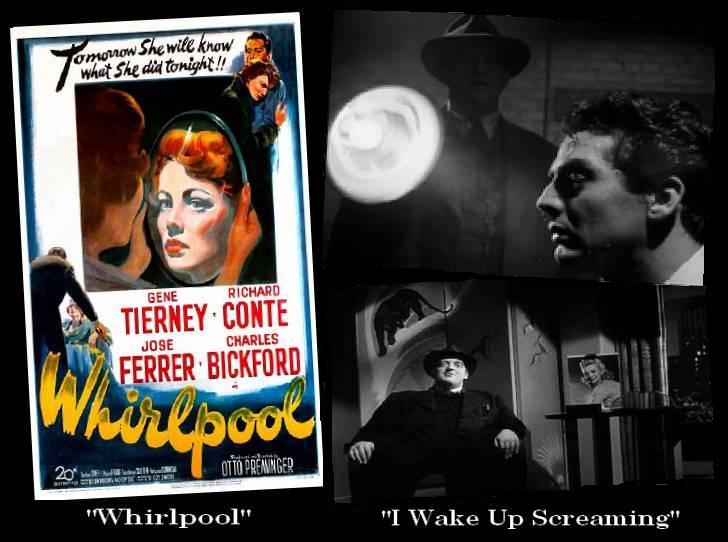
Whirlpool and I Wake Up Screaming

Christmas. Bah. Humbug. These are dark days. With good cheer in short supply, I’ve been watching movies from the Fox Film Noir collection.
Whirlpool stars Gene Tierney, Jose Ferrer, and noir icon Richard Conte. It’s a movie that I recall sort of half watching one summer evening in 1971 when it aired, as so many Fox titles did at the time, on a local television station’s late night movie. It’s an oddball little mystery from 1949 written by Ben Hecht and Andrew Solt (from a novel by Guy Endore) and directed by Otto Preminger who made quite a few contributions to this subgenre (including Laura) before directing a bunch of less interesting “prestige” items like Exodus and The Cardinal in the 1960s. Tierney is the wife of a psychiatrist who is taken under the wing of Ferrer’s hypnotist after she’s caught shoplifting. He then hypnotizes her to take the fall for a murder he commits himself. He has the motive, but he also has an alibi. While the victim was meeting her end, he was confined to a hospital bed, on the mend from a gallbladder operation. The nasty hypnotist (David Karvo is the character’s name) had hypnotized himself to block out the excruciating pain, snuck out of bed, and committed the crime. A little preposterous, perhaps, but fascinating stuff. Film noir is notable for many things, not the least of which is its perversity. Only the horror movies had more bizarre plots. Whirlpool is as weird as it gets, but it could have used a better title, something like . . .

I Wake Up Screaming.

Now, that’s a great title. All it needs is a movie as good, but the 1941 production directed by H. Bruce Humberstone, isn’t really it. It’s not surprising that Twentieth Century Fox considered renaming it Hot Spot and even had ads printed with that title before the movie went into release. If the movie isn’t quite worthy of its title, it does have an effective villain in Laird Cregar. The hulking, soft-voiced actor, a memorable menace in such films as Hangover Square and The Lodger, is first seen in shadow as he turns the hot lights on Victor Mature, a sports promoter being interrogated as a suspect in the murder of an actress. As the captain in charge of the case, Cregar ignores evidence of Mature’s innocence and even admits to investing his own time and money into finding a way to pin the rap on him. Cregar, of course, is the true culprit who we learn at the climax has a shrine to the murdered girl in his apartment. Betty Grable and Carole Landis round out the cast though I’d be hard-pressed to tell them apart, and Elisha Cook, Jr, who appeared as Wilmer the gunsel in The Maltese Falcon the same year, turns up briefly as a hotel desk clerk who is also a suspect. The best moment, and the only one that ties in with the title, is when Mature wakes up in his bed to find Cregar sitting in a nearby chair, rather nonchalantly keeping watch over him even as he sleeps. The movie, a fairly solid thriller, would be much improved without its musical score. Except for the snatches of “Over the Rainbow” (yes, that “Over the Rainbow” from The Wizard of Oz), I could swear the musical score is identical to the one in Whirlpool.

Merry Christmas.

© 2012 Brian W. Fairbanks

VISIT MY KINDLE STORE AT AMAZON